Short answer: a power station wins for outages under about a day, for anything that has to run indoors or silently, and for medical gear. A generator wins for multi-day outages and for 240V loads on a budget. A 2 kWh Anker SOLIX C2000 Gen 2 (about $900) runs a fridge, Wi-Fi and lights about 23 hours on one charge with no fuel and no exhaust. A Westinghouse iGen2550DFc ($500 to $1,000) runs the same loads plus a gas furnace blower for as long as you feed it, about 1.2 gallons of gas a day, or $3.84 at $3.20 a gallon.
Our picks at a glance
From published specs and our sizing rules. Not lab tested.
- 1
Power station: fridge and Wi-Fi
Anker SOLIX C2000 Gen 2
2,048 Wh battery
Check price at Anker SOLIXPaid link
- 2
Generator: fridge and furnace
Westinghouse iGen2550DFc Dual Fuel Inverter
1,900 running watts
Check price on AmazonPaid link
- 3
Power station: 240V well pump
Anker SOLIX F3800 Plus
3,840 Wh battery
Check price at Anker SOLIXPaid link
- 4
Generator: 240V whole house
Westinghouse iGen8200TFc Tri-Fuel Inverter
6,600 running watts
Check price on AmazonPaid link
The math, once: a battery gives capacity x 0.85 after inverter losses, divided by the average draw. A fridge (1,260 Wh a day), router (360) and four LED lamps (180) use 1,800 Wh a day, a 75 W average. The C2000 Gen 2 holds 2,048 Wh, so 2,048 x 0.85 = 1,741 Wh, and 1,741 / 75 = about 23 hours. A generator's fuel use comes from its tank size and rated run time, and a small inverter near idle burns about half its quarter-load rate: 1.1 gal / 11 hours x 0.5 x 24 = 1.2 gallons a day.
Many households end up with both: a power station for nights, CPAP and the router, and a generator to refill it and carry the heavy loads by day. The runtime table below ranks the batteries in this guide for your own loads.
Top picks, and why
Anker SOLIX C2000 Gen 2
- 2.0 kWh
- expands to 4 kWh
- 2,400 W continuous
2,048 Wh, 2,400 W, 10 ms UPS, 41.7 lb, about $900. About 23 hours of fridge, router and lights per charge, indoors and silent. Doubles to 4,096 Wh with one BP2000.
- TT-30 RV outlet for a camper
- Expands to 4,096 Wh, about 2 days of fridge
- 10 ms UPS switchover
- Expansion tops out at 4 kWh
- Not split-phase, no 240V
About $900 at Anker SOLIX, checked Oct 13, 2026
Check price at Anker SOLIXPaid link. We earn a commission at no cost to you.
Westinghouse iGen2550DFc Dual Fuel Inverter
- 1,900 W running
- 2,550 W starting
- gasoline / propane
- inverter
+1 moreFewer
- 52 dBA
1,900 W on gas, 1,700 W on propane, 52 dBA, CO sensor, $500 to $1,000. About 1.2 gallons of gas a day for a fridge, furnace blower and lights, for as long as the outage lasts.
- Runs a fridge, furnace blower and lights
- Dual fuel: gas or propane
- CO sensor and a 52 dBA noise level
- 1,700 W on propane, less than on gas
- Pull start only, no 240V outlet
$500 to $1,000, live price on Amazon
Check price on AmazonPaid link. We earn a commission at no cost to you.
Anker SOLIX F3800 Plus
- 3.8 kWh
- expands to 27 kWh
- 6,000 W continuous
- 120/240V
3,840 Wh, 6,000 W at 120/240V, 9,000 W surge, about $2,400. About 13 hours of fridge, freezer, furnace and well pump per charge, 26 hours with one BP3800.
- 120/240V split phase, so it can run 240V loads like a well pump
- 9,000 W surge covers a 1/2 HP well pump start
- 3,200 W solar input, more than the original F3800 (2,400 W)
- 137 lb, plan to keep it in one place
- 20 ms switchover, slower than the 0 ms Jackery Explorer 5000 Plus
About $2,400 at Anker SOLIX, checked Oct 13, 2026
Check price at Anker SOLIXPaid link. We earn a commission at no cost to you.
Westinghouse iGen8200TFc Tri-Fuel Inverter
- 6,600 W running
- 8,200 W starting
- gasoline / propane / natural gas
- inverter
+1 moreFewer
- 60 dBA
6,600 W on gas, 5,940 W on propane, 5,280 W on natural gas, 14-50R outlet, 60 dBA, $1,000 to $2,000. About 2.8 gallons of gas a day for the same well pump and furnace load.
- Runs on gas, propane or natural gas
- 240V 14-50R outlet, starts a 1/2 HP well pump
- Quietest 240V unit in our list with a dBA spec, 60 dBA
- 5,280 W on natural gas, 20 percent less than gas
$1,000 to $2,000, live price on Amazon
Check price on AmazonPaid link. We earn a commission at no cost to you.
Will it run your stuff?
Tick what you need to keep running. Every pick below re-sorts by how long it lasts on one charge.
Average draw about 104 W, peak about 1,251 W when the biggest motor starts.
- Check price at Anker SOLIX
Anker SOLIX F3800 Plus
3,840 Wh, About $2,400 at Anker SOLIX
about 32 hours
Paid link
- Check price at BLUETTI
BLUETTI Elite 200 V2
2,074 Wh, About $899 at BLUETTI
about 17 hours
Paid link
- Check price at Anker SOLIX
Anker SOLIX C2000 Gen 2
2,048 Wh, About $900 at Anker SOLIX
about 17 hours
Paid link
Runtime = capacity x 0.85 inverter efficiency / average draw, with fridges and freezers cycling on their compressors. Amazon links are paid links. Amazon prices change, so we show a range.
Compare every pick
Paid links: we earn a commission if you buy, at no cost to you. Amazon prices change often, so we show a range and link to the live price.
Head to head: cost, runtime, noise, indoor use and upkeep
Upfront cost: per watt of output, a generator is far cheaper. The Westinghouse iGen8200TFc ($1,000 to $2,000) makes 6,600 W; the Anker SOLIX F3800 Plus (about $2,400) makes 6,000 W but only stores 3,840 Wh. Per day of outage, the generator costs fuel and the battery costs nothing until it runs flat, after which it needs the grid, the sun or a generator.
Cost per day: at a 75 to 250 W household average, a small inverter burns about 1.2 gallons of gas a day and a 240V tri-fuel inverter about 2.8, roughly $3.84 and $8.96 at $3.20 a gallon. On propane, multiply the gallons by 1.4: the iGen8200TFc's 2.8 becomes about 3.9 gallons of propane, close to one 20 lb tank a day. A battery recharged from solar costs nothing per day, but the panels are extra, and you need about Wh per day / (sun hours x 0.75) watts of them: 1,800 Wh a day with 4 hours of full sun takes about 600 W of panels.
Noise: the generators here are rated 52 to 74 dBA at 23 ft. A power station has no engine; the only sound is its cooling fan. Indoor use: a power station has no exhaust and runs anywhere in the house. A generator must run outdoors, at least 20 ft from the house with the exhaust pointed away, never in a garage, with battery CO alarms on every sleeping level.
240V: only the split-phase batteries (Anker F3800 and F3800 Plus, EcoFlow DELTA Pro 3, BLUETTI Apex 300) run a 240V well pump, while any generator with an L14-30R or 14-50R outlet does. Upkeep and storage: a generator needs oil changes and fuel management, and untreated gasoline goes stale in months, while sealed propane keeps for years. A LiFePO4 power station needs no fuel; check the manual for its storage top-up interval, or leave it plugged in so it is full when the power goes out.
Fridge only: 2 kWh battery vs a 2,500 W inverter
Load: fridge, router and four LED lamps, 1,800 Wh a day (75 W average). A 2 kWh power station covers about 23 hours, a single overnight outage with margin. The fridge alone runs about 33 hours (1,741 / 52).
A 2,500 W inverter generator runs the same load indefinitely on about 1.2 gallons of gas a day, or one 20 lb propane tank every 2.7 days (1.2 x 1.4 = 1.7 gallons of propane a day). It has to sit outside and be refueled every 22 hours or so on its 1.1 gal tank.
Pick the battery if your outages are usually under a day, or if you also need a CPAP or a router on UPS. Pick the generator if outages in your area run several days.
Anker SOLIX C2000 Gen 2
- 2.0 kWh
- expands to 4 kWh
- 2,400 W continuous
2,048 Wh at 41.7 lb with a 10 ms UPS and 800 W of solar input, enough for about 600 W of panels in a 4-hour sun day. About 23 hours of fridge, router and lights.
- TT-30 RV outlet for a camper
- Expands to 4,096 Wh, about 2 days of fridge
- 10 ms UPS switchover
- Expansion tops out at 4 kWh
- Not split-phase, no 240V
About $900 at Anker SOLIX, checked Oct 13, 2026
Check price at Anker SOLIXPaid link. We earn a commission at no cost to you.
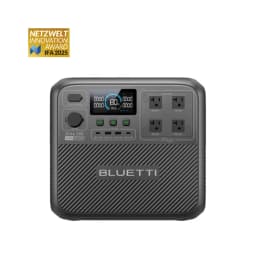
2,074Wh battery
BLUETTI Elite 200 V2
- 2.1 kWh
- 2,600 W continuous
2,074 Wh, 2,600 W, 1,000 W of solar input and a 10 ms UPS, 53.4 lb, about $899. About 23.5 hours of the same load. Not expandable.
- Rated for 6,000 cycles
- 2,600 W inverter and 10 ms UPS switchover
- About 34 hours of a full-size fridge per charge
- Not expandable
- Over 50 lb at 53.4 lb
About $899 at BLUETTI, checked Oct 10, 2026
Check price at BLUETTIPaid link. We earn a commission at no cost to you.
Westinghouse iGen2550DFc Dual Fuel Inverter
- 1,900 W running
- 2,550 W starting
- gasoline / propane
- inverter
+1 moreFewer
- 52 dBA
About 1.2 gallons of gas a day at this load and 22 hours per 1.1 gal tank, or a 20 lb propane tank every 2.7 days. 52 dBA with a CO sensor.
- Runs a fridge, furnace blower and lights
- Dual fuel: gas or propane
- CO sensor and a 52 dBA noise level
- 1,700 W on propane, less than on gas
- Pull start only, no 240V outlet
$500 to $1,000, live price on Amazon
Check price on AmazonPaid link. We earn a commission at no cost to you.
Fridge plus gas furnace: 4 kWh battery vs a generator
Add a gas furnace blower (2,400 Wh a day) and the load is 4,200 Wh a day, a 175 W average. A C2000 Gen 2 with one BP2000 battery (4,096 Wh, $1,000 to $2,000 together) gives 3,482 Wh, about 20 hours. An Anker F3800 Plus gives about 19 hours.
The same 2,500 W inverter still burns about 1.2 gallons a day here, because 175 W is below its idle floor. A furnace is hardwired, so either source needs a furnace transfer switch such as the EZ Generator Switch (under $100) to plug it in with a cord.
In a cold-climate outage that lasts days, this is where a generator pays off: about $3.84 a day of gas against a battery that needs refilling every day. Running a battery from solar in winter is harder, since short days give fewer sun hours.
Anker SOLIX BP2000 Expansion Battery (Gen 2)
- 2.0 kWh
Adds 2,048 Wh to a C2000 Gen 2 for 4,096 Wh total, about 20 hours of fridge, furnace blower, router and lights.
- Doubles a C2000 Gen 2 to about 4 kWh
- LiFePO4 cells, 4,000 cycles to 80%
- Battery-to-host cable included
- Built only for the C2000 Gen 2
- One pack per C2000 Gen 2
$500 to $1,000, live price on Amazon
Check price on AmazonPaid link. We earn a commission at no cost to you.
EZ Generator Switch furnace transfer switch
A listed manual transfer switch beside the furnace, so a hardwired blower runs from a generator or a battery through an extension cord. An electrician should mount it.
- UL / CSA listed manual transfer switch
- Lets a hardwired furnace run on a cord, no panel interlock
- Works with generators and battery inverters
- One circuit (the furnace) only
- An electrician should mount it at the furnace
Under $100, live price on Amazon
Check price on AmazonPaid link. We earn a commission at no cost to you.
Westinghouse iGen5000DFc Dual Fuel Inverter
- 3,900 W running
- 5,000 W starting
- gasoline / propane
- inverter
+1 moreFewer
- 52 dBA
3,900 W on gas, 3,500 W on propane, 52 dBA, 18 hours a tank, electric start. Add a 120V sump pump or microwave without hitting the limit. About 2.3 gallons a day at this load.
- Gas (3,900 W) or propane (3,500 W)
- Adds a CO sensor over the gas-only iGen5000
- 18 hours at quarter load, 52 dBA
- No 240V outlet for a 240V well pump
- Over 100 lb at 105.8 lb
$500 to $1,000, live price on Amazon
Check price on AmazonPaid link. We earn a commission at no cost to you.
Whole house with a 240V well pump
Load: fridge, chest freezer, gas furnace blower, 1/2 HP 240V well pump, router and lights, 5,920 Wh a day, about a 247 W average. Running total is about 1,900 W, and the well pump's start pushes the peak near 3,900 W, so you need 240V and real surge.
Battery: the Anker F3800 Plus (6,000 W, 9,000 W surge) gives 3,264 Wh, about 13 hours. With one BP3800 (about $1,800) it gives 6,528 Wh, about 26 hours, for about $4,200 together. To keep up from solar alone you would need about 2,000 W of panels in a 4-hour sun day (5,920 / 3).
Generator: the Westinghouse iGen8200TFc burns about 2.8 gallons of gas a day at this load, or runs from a natural gas line with no refueling at 5,280 W. The Westinghouse WGen9500DF ($500 to $1,000) is a cheaper 9,500 W open-frame unit, but at 74 dBA, with no CO sensor on this version and a conventional engine, it burns about 6.6 gallons a day at the same load. Either generator needs an interlock or transfer switch and an inlet box, installed by an electrician.
Anker SOLIX F3800 Plus
- 3.8 kWh
- expands to 27 kWh
- 6,000 W continuous
- 120/240V
6,000 W at 120/240V with up to 26,880 Wh of expansion and 3,200 W of solar input. About 13 hours of this load per charge, silent and indoors.
- 120/240V split phase, so it can run 240V loads like a well pump
- 9,000 W surge covers a 1/2 HP well pump start
- 3,200 W solar input, more than the original F3800 (2,400 W)
- 137 lb, plan to keep it in one place
- 20 ms switchover, slower than the 0 ms Jackery Explorer 5000 Plus
About $2,400 at Anker SOLIX, checked Oct 13, 2026
Check price at Anker SOLIXPaid link. We earn a commission at no cost to you.
Anker SOLIX BP3800 Expansion Battery
- 3.8 kWh
Adds 3,840 Wh to an F3800 or F3800 Plus, taking this whole-house load from about 13 to about 26 hours.
- Adds 3.84 kWh, over two days of a full-size fridge alone
- Fits both the F3800 and F3800 Plus
- Six packs take a station to 26.9 kWh
- Max six per station
About $1,800 at Anker SOLIX, checked Oct 13, 2026
Check price at Anker SOLIXPaid link. We earn a commission at no cost to you.
Westinghouse iGen8200TFc Tri-Fuel Inverter
- 6,600 W running
- 8,200 W starting
- gasoline / propane / natural gas
- inverter
+1 moreFewer
- 60 dBA
Gas, propane or natural gas, 14-50R outlet, 60 dBA and a CO sensor. About 2.8 gallons of gas a day for this load.
- Runs on gas, propane or natural gas
- 240V 14-50R outlet, starts a 1/2 HP well pump
- Quietest 240V unit in our list with a dBA spec, 60 dBA
- 5,280 W on natural gas, 20 percent less than gas
$1,000 to $2,000, live price on Amazon
Check price on AmazonPaid link. We earn a commission at no cost to you.
Westinghouse WGen9500DF Dual Fuel
- 9,500 W running
- 12,500 W starting
- gasoline / propane
- 74 dBA
9,500 W on gas, 8,500 W on propane, 12,500 W starting, 14-50R and L14-30R, remote start. 74 dBA and no CO sensor on this version, so it needs careful placement.
- 9,500 W on gas, 8,500 W on propane
- 14-50R and L14-30R outlets, remote start
- 12,500 starting watts starts a well pump with the house loads running
- Not an inverter, loud at 74 dBA
- No CO sensor on this version
$500 to $1,000, live price on Amazon
Check price on AmazonPaid link. We earn a commission at no cost to you.
The bottom line
From published specs and our sizing rules. Not lab tested.
- 1
Power station: fridge and Wi-Fi
Anker SOLIX C2000 Gen 2
2,048 Wh battery
Check price at Anker SOLIXPaid link
- 2
Generator: fridge and furnace
Westinghouse iGen2550DFc Dual Fuel Inverter
1,900 running watts
Check price on AmazonPaid link
- 3
Power station: 240V well pump
Anker SOLIX F3800 Plus
3,840 Wh battery
Check price at Anker SOLIXPaid link
- 4
Generator: 240V whole house
Westinghouse iGen8200TFc Tri-Fuel Inverter
6,600 running watts
Check price on AmazonPaid link
Frequently asked questions
Is a generator or a power station better for a power outage?
A power station for outages under about a day, indoor use and medical gear. A generator for multi-day outages and 240V loads on a budget. A 2 kWh power station runs a fridge, router and lights about 23 hours; a 2,500 W inverter generator runs them indefinitely on about 1.2 gallons of gas a day.
How much does it cost per day to run a generator in an outage?
About 1.2 gallons of gas a day for a small 2,500 W inverter at a light fridge and furnace load, about $3.84 at $3.20 a gallon. A 240V tri-fuel inverter like the iGen8200TFc burns about 2.8 gallons, and a conventional 9,500 W open-frame unit about 6.6 gallons at the same load.
How long will a power station run a refrigerator?
Capacity x 0.85 / 52 W for a typical full-size fridge: about 17 hours for 1 kWh, 33 hours for 2 kWh and 63 hours for the 3,840 Wh Anker F3800 Plus. Add a router and lights and a 2 kWh unit drops to about 23 hours.
Can I run a power station indoors?
Yes. A power station has no engine and no exhaust, so it can run in a bedroom or kitchen. A gas generator must run outdoors, at least 20 ft from the house, never in a garage, even with a CO shutoff.
Can a power station run a well pump?
A 240V well pump needs a split-phase unit such as the Anker SOLIX F3800 Plus, EcoFlow DELTA Pro 3 or BLUETTI Apex 300. The F3800 Plus runs a fridge, freezer, furnace blower and 1/2 HP well pump about 13 hours per charge. A 120V-only power station cannot run a 240V pump.
Is a solar generator worth it compared with a gas generator?
Worth it if you want silent, indoor, fuel-free backup and can mount enough panels: about 600 W of panels refills a day of fridge, router and lights in 4 hours of full sun. For multi-day winter outages with a furnace and well pump, a gas or propane generator is the cheaper way to keep up.
Which is quieter, a generator or a power station?
A power station, which has no engine; you hear only its cooling fan. The quietest generators here are rated 52 dBA at 23 ft, and the open-frame WGen9500DF 74 dBA.
How long can you store a generator vs a power station?
A generator's gasoline goes stale in months, so stored gas needs stabilizer and rotation, and the engine needs oil changes and exercise runs. Propane keeps for years in a sealed tank. A LiFePO4 power station needs no fuel; follow the manual's top-up interval or leave it plugged in.
Can a generator charge a power station?
Yes. Plug the power station's AC charger into the generator like any other load. That lets a small generator run a few hours a day to refill the battery, while the battery carries nights and quiet hours.
14 products are linked on this page. We have not lab-tested these products; picks are based on published specifications and our sizing rules. Amazon prices change, so we show a range and link to the live price. See our disclosure.
Size it for your home
Related guides
- Best Solar Generator for Home Backup in 2026
- Best Portable Generator for Home Backup in 2026
- Anker SOLIX vs EcoFlow: Which Power Station to Buy
- Westinghouse vs Champion Inverter Generators
- Best Generator for a Well Pump: 240V Models With the Surge to Start It
- How to Connect a Generator to Your House Safely
More backup power guides
- Cheapest Power Station Per Watt-Hour: Most Battery for the Money
- Cheapest Solar Panels for a Power Station (Cost per Watt)
- FOSSiBOT vs BLUETTI: Which Power Station to Buy
- How Long Does a 20 lb Propane Tank Last on a Generator?
- Jackery vs EcoFlow vs BLUETTI: Which Brand to Buy
- EcoFlow DELTA 3 Plus vs Jackery Explorer 1000 v2
- Power Outage Kit Checklist: What to Buy, Tier by Tier
- Best Heat Source for a Power Outage: What Keeps You Warm
- How Long Will a Power Station Run a Space Heater?
- Best Portable Power Station Under $500 for Outages
- Best Power Station for a CPAP, Sized Night by Night
- Best Dual Fuel Inverter Generators for 2026
- Best Home Battery Backup Without an Installer: Plug-In Systems Compared
- Best Power Station for a Refrigerator: Hours of Cold per Charge
- Best Generator Interlock Kits and Transfer Switches for 2026
- Best Off-Grid Solar Kit for a Cabin, Shed or RV (Sized by Daily Watt-Hours)
- Best Generator for a Furnace: What Size Runs Your Heat in an Outage
- Anker SOLIX vs BLUETTI: Which Power Station to Buy
- Honda EU2200i vs Westinghouse iGen2550: Which to Buy
Marcus Reed
Founder and Editor, CrunchYourDollars
Marcus Reed builds the sizing tools on CrunchYourDollars. He is a software engineer with a long-running PC hardware and power supply habit, which is where the watts, watt-hours and surge math on this site comes from. Product specs are pulled from manufacturer data sheets, electricity rates from the U.S. Energy Information Administration, and water chemistry rules from the Water Quality Association. He is not a licensed electrician or plumber: the tools show the math and the matching models so you can make the call, and anything involving your electrical panel should be checked by a licensed pro.
More about CrunchYourDollars and how we researchGet notified when we add tools
An occasional email when a new sizing tool goes live or the product database is refreshed. No spam, unsubscribe anytime.