Start with the Anker SOLIX F3800 Plus. It gives most houses whole-home style backup without a permit, a battery installer or a five-figure quote: 3,840 Wh, 6,000 W continuous and 120/240V split phase from one box, with room for six expansion batteries. If you want to start bigger, the EcoFlow DELTA Pro Ultra begins at 6,144 Wh and 7,200 W and has the cheapest expansion batteries per kWh. For 240V on the smallest budget, get the BLUETTI Apex 300.
Our picks at a glance
From published specs and our sizing rules. Not lab tested.
- 1
Best overall
Anker SOLIX F3800 Plus
3,840 Wh battery
Check price at Anker SOLIXPaid link
- 2
Best for bigger homes
EcoFlow DELTA Pro Ultra
6,144 Wh battery
Check price on AmazonPaid link
- 3
Cheapest 240V
BLUETTI Apex 300
2,765 Wh battery
Check price at BLUETTIPaid link
These are portable home batteries, which means LiFePO4 packs on wheels. They charge from a wall outlet, have household outlets on the front, and can also feed a transfer switch or smart panel. If you run appliances on cords, you really do not need an installer. Backing up hardwired circuits like the furnace, well pump or anything 240V still means an electrician fits an inlet, interlock or smart panel. That is a few hours of normal electrical work. It is a long way from a permitted energy storage install with inspections.
The purchase comes down to kWh (how long it runs), continuous watts (how much at once) and surge watts (whether a motor will start), plus a yes or no on 240V split phase output. Below we go through each one, price out a full expansion stack, compare transfer switch, smart panel and cords, and say plainly when an installed Powerwall 3 or FranklinWH is the better buy.
Top picks, and why
Anker SOLIX F3800 Plus
- 3.8 kWh
- expands to 27 kWh
- 6,000 W continuous
- 120/240V
3,840 Wh and 6,000 W continuous (9,000 W surge) with 120/240V split phase from a single unit, so a well pump, furnace and refrigerator can all run from one box. Six BP3800 packs take it to 26,880 Wh. It accepts 3,200 W of solar, and Anker's Home Power Panel adds 20 ms automatic switchover. It sells for about $2,400.
- 120/240V split phase, so it can run 240V loads like a well pump
- 9,000 W surge covers a 1/2 HP well pump start
- 3,200 W solar input, more than the original F3800 (2,400 W)
- 137 lb, plan to keep it in one place
- 20 ms switchover, slower than the 0 ms Jackery Explorer 5000 Plus
About $2,400 at Anker SOLIX, checked Oct 13, 2026
Check price at Anker SOLIXPaid link. We earn a commission at no cost to you.
EcoFlow DELTA Pro Ultra
- 6.1 kWh
- expands to 31 kWh
- 7,200 W continuous
- 120/240V
Starts at 6,144 Wh and 7,200 W (10,800 W surge) at 120/240V, so the base unit alone covers a full day of essentials. Extra batteries are 6,144 Wh for $1,000 to $2,000, the lowest cost per kWh of any expansion pack here, and one inverter scales to 30,720 Wh. It sells for over $2,000.
- 7,200 W at 120/240V, can run 240V loads like a well pump
- Expands to 30.7 kWh with five extra batteries
- 5,600 W solar input, more than any Anker or BLUETTI unit here
- 164 lb with one battery, heavy to move
- 6 AC outlets vs 8 on the Anker F3800 models
Over $2,000, live price on Amazon
Check price on AmazonPaid link. We earn a commission at no cost to you.
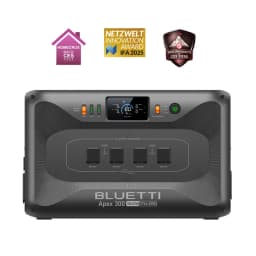
2,765Wh battery
BLUETTI Apex 300
- 2.8 kWh
- expands to 19 kWh
- 3,840 W continuous
- 120/240V
2,765 Wh and 3,840 W continuous (7,680 W surge) with 120/240V output for around $1,599, the lowest entry price for split phase in our database. B300K packs add 2,765 Wh each up to 19,354 Wh, and its 10 ms UPS switchover beats Anker's and EcoFlow's. Skip it if you need two large motors running at the same time.
- 120V and 240V output, can run a 240V well pump
- 84 lb, the lightest 240V unit in this list
- Expands to 19.4 kWh with up to six B300K packs
- 3,840 W continuous, the lowest of the 240V units here
- 2.8 kWh base, the smallest starting capacity with 240V
About $1,599 at BLUETTI, checked Oct 10, 2026
Check price at BLUETTIPaid link. We earn a commission at no cost to you.
Will it run your stuff?
Tick what you need to keep running. Every pick below re-sorts by how long it lasts on one charge.
Average draw about 104 W, peak about 1,251 W when the biggest motor starts.
- Check price on Amazon
EcoFlow DELTA Pro Ultra X
12,288 Wh, Over $2,000
about 4 days
Paid link
- Check price on Amazon
EcoFlow DELTA Pro Ultra
6,144 Wh, Over $2,000
about 2 days
Paid link
- Check price on Amazon
Jackery Explorer 5000 Plus
5,040 Wh, Over $2,000
about 41 hours
Paid link
- Check price at Anker SOLIX
Anker SOLIX F3800 Plus
3,840 Wh, About $2,400 at Anker SOLIX
about 32 hours
Paid link
- Check price at BLUETTI
BLUETTI Apex 300
2,765 Wh, About $1,599 at BLUETTI
about 23 hours
Paid link
- Check price at BLUETTI
BLUETTI Elite 200 V2
2,074 Wh, About $899 at BLUETTI
about 17 hours
Paid link
Runtime = capacity x 0.85 inverter efficiency / average draw, with fridges and freezers cycling on their compressors. Amazon links are paid links. Amazon prices change, so we show a range.
Compare every pick
Paid links: we earn a commission if you buy, at no cost to you. Amazon prices change often, so we show a range and link to the live price.
kWh, kW and surge: the three numbers that matter
Kilowatt-hours are runtime. In most homes the essentials use 4 to 7 kWh a day. That covers the refrigerator, a chest freezer, the furnace blower or boiler, a well pump cycling, lights, Wi-Fi, phones and one TV. Our sizing rule is needed Wh = daily Wh x days x 1.2 / 0.9, which keeps a 20 percent reserve and allows for inverter losses. For 5 kWh a day and one night, that comes to 6,667 Wh. The DELTA Pro Ultra covers it on its own, the F3800 Plus needs one BP3800, and the Apex 300 needs two B300K packs.
Continuous watts are how much runs at once. Add up what is on at the same moment. A refrigerator runs at about 150 W, a furnace blower at 500 to 800 W, a well pump at about 1,000 W, a microwave at 1,200 W and a space heater at 1,500 W. All of that fits inside the Apex 300's 3,840 W. With 6,000 to 7,200 W, the Anker and EcoFlow units leave room for a window air conditioner or an electric dryer on top.
Surge is the motor start. A 1/2 HP well pump pulls about 3,000 W for a fraction of a second, and a central air compressor pulls far more. Every 240V unit here surges at least 7,680 W, so one pump is fine. Do not plan on starting central air on anything below the DELTA Pro Ultra X (12,000 W continuous). Even there, a soft starter on the condenser is the sensible add.
240V split phase decides the whole purchase
Most US homes have at least one 240V load: a well pump, electric water heater, dryer, range or central air. A 120V-only battery cannot run any of them no matter how many kWh it holds. On a well, 240V is non-negotiable. That rules out the BLUETTI Elite 200 V2 and the Jackery HomePower 3600 Plus, which is 120V only unless you buy two and pair them.
In our database, these units put out 120/240V from a single box: the Anker F3800 Plus and original F3800, the EcoFlow DELTA Pro Ultra, Ultra X and DELTA Pro 3, the BLUETTI Apex 300 and the Jackery Explorer 5000 Plus. The DELTA Pro 3 (4,096 Wh, 4,000 W, over $2,000) is the smallest EcoFlow that does it. If the pump is your only reason for needing 240V, the Apex 300 gets you there for a lot less.
Expansion batteries and what a full stack really costs
The base unit is the cheap part. Anker's BP3800 is 3,840 Wh for about $1,800 ($469 per kWh), up to six, so a full 26,880 Wh F3800 Plus stack is $13,200. The EcoFlow DELTA Pro Ultra Extra Battery is 6,144 Wh for $1,000 to $2,000 ($293 per kWh), with four more per inverter for 30,720 Wh total at $11,399. BLUETTI's B300K is 2,765 Wh for $1,199 ($434 per kWh), up to six, so a full 19,354 Wh Apex 300 stack is $8,793. The Ultra X takes eight more EcoFlow packs to reach 61,440 Wh, about $22,099 all in.
So BLUETTI is the cheapest way to start and EcoFlow is the cheapest way to get big. Take two nights at 5 kWh a day, which needs 13,333 Wh. An F3800 Plus with three BP3800 packs gives 15,360 Wh for $7,800. A DELTA Pro Ultra with two extra batteries gives 18,432 Wh for $7,799. An Apex 300 with four B300K packs gives 13,825 Wh for $6,395. Above roughly 12 kWh the EcoFlow stack costs less per stored kWh than either competitor.
You do not have to buy the stack up front. All three base units accept packs later. Buy the base unit now, add one expansion after the first outage shows you how fast it drains, and add more only if you keep running short.
Budget, maximum capacity and true UPS picks
Not every home needs 240V or 20 kWh. An apartment, or a gas-heated house on city water, needs a refrigerator, lights, a router and phone charging through the night, and a 2 kWh unit on cords does that for under $1,000. At the far end, a home that wants central air and a multi-day margin needs a 12 kW class inverter and a stack that grows past 30 kWh.
The three picks below cover those cases. One is the cheapest sensible backup in the database and one is the largest plug-in stack sold direct. The third is the only unit that claims a zero-gap UPS mode, which matters for a home server, medical equipment or a sump pump controller that trips on a flicker.
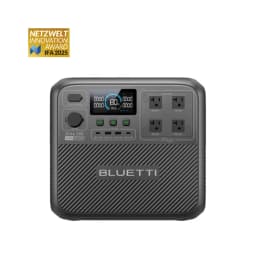
2,074Wh battery
BLUETTI Elite 200 V2
- 2.1 kWh
- 2,600 W continuous
2,074 Wh and 2,600 W for around $899 runs a refrigerator, furnace blower, router and lights for a day. It is 120V only, not expandable and cannot feed a transfer switch, so plan on cords. Good for apartments, condos and gas-heated homes on city water. Wrong for anyone with a well.
- Rated for 6,000 cycles
- 2,600 W inverter and 10 ms UPS switchover
- About 34 hours of a full-size fridge per charge
- Not expandable
- Over 50 lb at 53.4 lb
About $899 at BLUETTI, checked Oct 10, 2026
Check price at BLUETTIPaid link. We earn a commission at no cost to you.
EcoFlow DELTA Pro Ultra X
- 12 kWh
- expands to 61 kWh
- 12,000 W continuous
- 120/240V
12,288 Wh and 12,000 W at 120/240V in the base bundle, expandable to 61,440 Wh, with 10,000 W of solar input. No other plug-in stack here has the inverter headroom for central air on top of everything else. It sells for over $2,000 before extra batteries. It weighs 292 lb, so decide where it lives before it arrives.
- 12,000 W at 120/240V, the highest output in this list
- 12.3 kWh in the base bundle, expandable to 61.4 kWh
- 10,000 W solar input, the highest here
- 292 lb base bundle, the heaviest system here
- 20 ms switchover, not a 0 ms UPS
Over $2,000, live price on Amazon
Check price on AmazonPaid link. We earn a commission at no cost to you.
Jackery Explorer 5000 Plus
- 5.0 kWh
- expands to 30 kWh
- 7,200 W continuous
- 120/240V
5,040 Wh and 7,200 W (14,400 W surge) with 120/240V and a 0 ms UPS rating, the only unit in our database that claims no switchover gap at all. Five 5,040 Wh packs expand it to 30,240 Wh. It sells for over $2,000, though the expansion packs cost about $516 per kWh, well above EcoFlow's $293.
- 0 ms UPS mode, the fastest switchover here
- 7,200 W at 120/240V with a 14,400 W surge
- Pairs with Jackery's 60 A smart transfer switch
- 132 lb, plan to keep it in one place
Over $2,000, live price on Amazon
Check price on AmazonPaid link. We earn a commission at no cost to you.
Transfer switch, smart panel or extension cords
Cords are the true no-install option. Run heavy-gauge 12 AWG extension cords from the battery to the refrigerator, freezer, router, a lamp and a CPAP, and you are covered for the night with zero electrical work. Cords cannot reach anything hardwired (furnace, well pump, boiler) or anything 240V. This is the right setup for the Elite 200 V2 class.
A manual transfer switch or interlock kit is the middle path. An electrician fits a 240V inlet (L14-30 or 14-50) on the outside wall and either a 6 to 10 circuit transfer switch or an interlock on the main panel. Hardware runs $150 to $500, and the labor takes a few hours. In an outage you plug the battery's 240V outlet into the inlet, flip the interlock and choose which breakers to run. Nothing happens automatically, so the refrigerator stays off until you walk out there.
A smart panel makes it automatic. Anker's Home Power Panel (around $1,200) and EcoFlow's Smart Home Panel 2 ($1,000 to $2,000, 12 circuits) are subpanels that move your chosen circuits to the battery in 20 ms when the grid drops, then back when it returns. You still need an electrician, but most jurisdictions treat it as a subpanel install and not a permitted energy storage system. A few treat any panel-tied battery as an ESS, so check locally.
UPS mode, solar recharge and when to hire an installer instead
UPS switchover is 20 ms on the F3800 Plus and DELTA Pro Ultra, 10 ms on the Apex 300 and DELTA Pro 3, and 0 ms on the Explorer 5000 Plus. Computers, routers and most electronics ride through 20 ms. Keep in mind that UPS mode only protects what is plugged into the unit directly or routed through a smart panel. A manual transfer switch gets no UPS protection.
Solar input is 3,200 W on the F3800 Plus, 5,600 W on the DELTA Pro Ultra, 2,400 W on the Apex 300 and 10,000 W on the Ultra X. Panels are sold separately, and real yield runs below the spec. 1,600 W of panels over four peak sun hours returns about 5 kWh after losses, which happens to match a day of essentials in sunny weather.
Once your needs outgrow this class, an installed system makes sense. A Tesla Powerwall 3 is 13.5 kWh and 11.5 kW continuous, and a FranklinWH aPower 2 is 15 kWh and 10 kW. Both back up the entire panel automatically, integrate with rooftop solar and stack past 40 kWh. Get an installed quote if you want central air on battery, already have rooftop solar, or were about to spend $12,000 or more on portable packs. Portable wins for renters, anyone who moves, anyone under about 15 kWh, and anyone who wants it working this week.
The bottom line
From published specs and our sizing rules. Not lab tested.
- 1
Best overall
Anker SOLIX F3800 Plus
3,840 Wh battery
Check price at Anker SOLIXPaid link
- 2
Best for bigger homes
EcoFlow DELTA Pro Ultra
6,144 Wh battery
Check price on AmazonPaid link
- 3
Cheapest 240V
BLUETTI Apex 300
2,765 Wh battery
Check price at BLUETTIPaid link
Frequently asked questions
How many kWh do I need for one night of essentials?
Most homes use 4 to 7 kWh a day on essentials. Using needed Wh = daily Wh x days x 1.2 / 0.9, a 5 kWh day for one night is 6,667 Wh. A DELTA Pro Ultra alone (6,144 Wh) gets close enough with a little rationing. An F3800 Plus plus one BP3800 gives 7,680 Wh, and an Apex 300 plus two B300K packs gives 8,295 Wh. Run your own numbers in our home battery sizer.
Can the Anker F3800 Plus run a well pump?
Yes. It outputs 120/240V split phase at 6,000 W continuous and 9,000 W surge. A 1/2 HP pump needs about 3,000 W to start and about 1,000 W while running, and a pump that runs a total of one hour a day uses roughly 1 kWh of the 3,840 Wh capacity. The pump has to be fed through an inlet and transfer switch or a smart panel. A cord will not work.
Can I backfeed the house through my dryer outlet?
No. A so-called suicide cord into a dryer or range outlet energizes the utility lines outside your house and can kill a line worker. It is illegal everywhere in the US and voids your insurance. The correct version of that idea is an interlock kit or transfer switch with a proper inlet, which costs $150 to $500 in parts.
What does a full Anker F3800 Plus stack cost?
The F3800 Plus is about $2,400 and each BP3800 expansion battery is about $1,800. Six packs is the maximum, so a full 26,880 Wh stack is about $13,200. Add the Home Power Panel at around $1,200 for automatic switchover and the hardware total is about $14,400 before the electrician.
Is a battery cheaper than a generator?
Up front, no. A dual-fuel inverter generator capable of 240V costs $1,000 to $1,500 and runs as long as you have fuel. A battery is silent, runs indoors, needs no fuel and starts instantly, but it stores a fixed amount. For long outages the best setup is both. The battery carries the night, and a small generator recharges it through the AC input for a few hours a day instead of running nonstop.
How long do these batteries last?
All of the units here use LiFePO4 cells, which manufacturers rate at roughly 3,000 to 4,000 full cycles before capacity drops to 80 percent. For a unit that sits on standby and cycles during outages, that is well over ten years. Store it between about 20 and 80 percent charge, and give it a full charge every few months so the battery gauge stays accurate.
Can any of these run central air conditioning?
A 3-ton central air unit draws about 3,500 W running but several times that at compressor start unless a soft starter is fitted. Only the DELTA Pro Ultra X at 12,000 W continuous has the headroom, and we would still fit a soft starter. On any other unit, plan for a window air conditioner (500 to 1,500 W).
Do I need a permit?
Running appliances on cords needs nothing. Fitting an inlet with an interlock or transfer switch, or installing a smart subpanel, is electrical work that normally requires a permit and an electrician, the same as a generator inlet. It is a routine job. An installed Powerwall or FranklinWH system goes through engineering review and utility interconnection, and these do not.
How much solar does it take to recharge a home battery?
About 1,600 W of panels returns about 5 kWh on a day with four peak sun hours, after losses, which matches a day of essentials in good weather. The unit's solar input caps how much you can add: 3,200 W on the F3800 Plus, 5,600 W on the DELTA Pro Ultra, 2,400 W on the Apex 300 and 10,000 W on the Ultra X. Panels are sold separately, and cloudy or winter days return much less.
Is a plug-in home battery or a Tesla Powerwall better?
It depends on how much you need and how long you will stay. A Powerwall 3 is 13.5 kWh and 11.5 kW continuous and a FranklinWH aPower 2 is 15 kWh and 10 kW, and both back up the whole panel automatically and pair with rooftop solar. A plug-in battery is the better fit for renters, anyone who may move, anyone under about 15 kWh and anyone who wants backup this week without a permitted install.
6 products are linked on this page. We have not lab-tested these products; picks are based on published specifications and our sizing rules. Amazon prices change, so we show a range and link to the live price. See our disclosure.
Size it for your home
Marcus Reed
Founder and Editor, CrunchYourDollars
Marcus Reed builds the sizing tools on CrunchYourDollars. He is a software engineer with a long-running PC hardware and power supply habit, which is where the watts, watt-hours and surge math on this site comes from. Product specs are pulled from manufacturer data sheets, electricity rates from the U.S. Energy Information Administration, and water chemistry rules from the Water Quality Association. He is not a licensed electrician or plumber: the tools show the math and the matching models so you can make the call, and anything involving your electrical panel should be checked by a licensed pro.
More about CrunchYourDollars and how we researchGet notified when we add tools
An occasional email when a new sizing tool goes live or the product database is refreshed. No spam, unsubscribe anytime.