Free calculator
Home Battery Backup Calculator
Find the kWh and kW your essential circuits need during an outage, whether you need 240V, and which portable whole-home battery systems fit, with the expansion packs and hookup costed out.
Short answer
Most homes need 10 to 25 kWh of battery to ride out a 2 to 3 day outage on essentials. A fridge, gas furnace blower, Wi-Fi, lights and phones use about 4.2 kWh a day, which after a 20% reserve and inverter losses is 5.6 kWh for one day, 11.3 kWh for two and 16.9 kWh for three. Add a 1/2 HP well pump and a sump pump and three days takes 24.1 kWh, with 120/240V output to start the pump. Just a fridge, router and lights for a day fits a 2.4 kWh power station. For long outages, compare a solar generator with a fuel generator, or enter your own loads below.
Updated Nov 8, 2026
- Answer a few questions
- See the math behind every number
- Get models that actually fit
Every home battery system this tool can recommend
Base units sorted by capacity. Expansion batteries and panels are added by the tool when your numbers call for them.
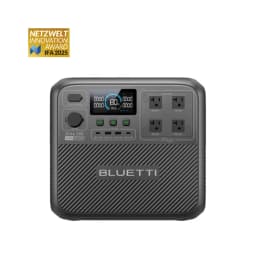
2,074Wh battery
BLUETTI Elite 200 V2
- 2.1 kWh
- 2,600 W continuous
2 kWh, 2.6 kW, 120V only and not expandable. The budget pick for fridge, furnace blower, Wi-Fi and lights for a day.
- 53 lb, the lightest unit here
- Runs a full-size fridge alone for about a day
- 10 ms switchover
- 120V only, no 240V output
- Not expandable, 2 kWh is the ceiling
About $899 at BLUETTI, checked Oct 10, 2026
Check price at BLUETTIPaid link. We earn a commission at no cost to you.
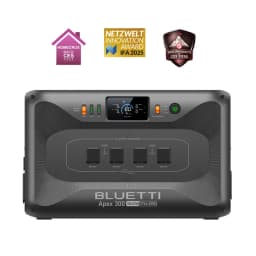
2,765Wh battery
BLUETTI Apex 300
- 2.8 kWh
- expands to 19 kWh
- 3,840 W continuous
- 120/240V
2.8 kWh and 3.8 kW with 120V and 240V output from one unit. Cheapest way into 240V, and you add B300K packs as you go.
- 120V and 240V output, can run a 240V well pump
- 84 lb, the lightest 240V unit in this list
- Expands to 19.4 kWh with up to six B300K packs
- 3,840 W continuous, the lowest of the 240V units here
- 2.8 kWh base, the smallest starting capacity with 240V
About $1,599 at BLUETTI, checked Oct 10, 2026
Check price at BLUETTIPaid link. We earn a commission at no cost to you.
Jackery HomePower 3600 Plus
- 3.6 kWh
- expands to 22 kWh
- 3,600 W continuous
3.6 kWh and 3.6 kW on 120V, expandable to 21 kWh. Needs a second unit for 240V, so it suits homes with no well pump or 240V loads.
- 3,600 W on 120V, expands to 21.5 kWh with five packs
- 77 lb, lighter than every unit here except the Elite 200 V2
- Home panel compatible
- 120V only, needs a second unit for 240V
- Not for well pumps or other 240V loads on one unit
$1,000 to $2,000, live price on Amazon
Check price on AmazonPaid link. We earn a commission at no cost to you.
Anker SOLIX F3800 Plus
- 3.8 kWh
- expands to 27 kWh
- 6,000 W continuous
- 120/240V
The most common starting point for whole-home backup: 120/240V from one box, 6 kW, and up to six add-on batteries.
- 120/240V split phase, so it can run 240V loads like a well pump
- 9,000 W surge covers a 1/2 HP well pump start
- 3,200 W solar input, more than the original F3800 (2,400 W)
- 137 lb, plan to keep it in one place
- 20 ms switchover, slower than the 0 ms Jackery Explorer 5000 Plus
About $2,400 at Anker SOLIX, checked Oct 13, 2026
Check price at Anker SOLIXPaid link. We earn a commission at no cost to you.
Show all 11 modelsShow fewer
Anker SOLIX F3800 (original)
- 3.8 kWh
- expands to 27 kWh
- 6,000 W continuous
- 120/240V
Same battery, inverter and 240V output as the Plus with slower AC and solar charging. Worth it when it is on sale well below the Plus.
- Same 6,000 W, 120/240V output as the F3800 Plus
- Expands to 26.9 kWh with up to six BP3800 batteries
- 2,400 W solar input vs 3,200 W on the F3800 Plus
- Slower AC charging than the F3800 Plus
About $1,980 at Anker SOLIX, checked Oct 13, 2026
Check price at Anker SOLIXPaid link. We earn a commission at no cost to you.
EcoFlow DELTA Pro 3
- 4.1 kWh
- expands to 12 kWh
- 4,000 W continuous
- 120/240V
4 kWh and 4 kW with 120V and 240V from a single unit. The smallest box here that can run a 240V well pump.
- 120V and 240V from one unit, can run a 240V well pump
- 8,000 W surge covers a 1/2 HP well pump start
- 10 ms switchover, faster than the 20 ms Anker and Ultra units
- Expands to 12.3 kWh, the lowest ceiling of the 240V units here
- 4,000 W continuous, about two thirds of the F3800 Plus
Over $2,000, live price on Amazon
Check price on AmazonPaid link. We earn a commission at no cost to you.
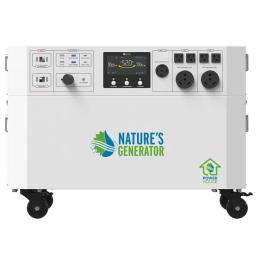
4,800Wh battery
Nature's Generator Powerhouse Gen 2
- 4.8 kWh
- 7,200 W continuous
- 120/240V
7.2 kW at 120/240V with 4.8 kWh built in, sold direct. For a home that needs 240V for a well pump and plans to stay on one unit.
- 7,200 W at 120/240V with an L14-30R outlet for a transfer switch
- 14,400 W peak for motor starts (maker)
- 10 ms UPS switchover
- 434 lb (maker), so it stays where it is delivered
- Add-on Power Pods are sold only in bundles with solar panels
- Curbside freight delivery
About $2,800 at Nature's Generator, checked Oct 19, 2026
Check price at Nature's GeneratorPaid link. We earn a commission at no cost to you.
Jackery Explorer 5000 Plus
- 5.0 kWh
- expands to 30 kWh
- 7,200 W continuous
- 120/240V
5 kWh and 7.2 kW with 120/240V from one unit and a 0 ms UPS mode. Pairs with Jackery's 60 A smart transfer switch.
- 0 ms UPS mode, the fastest switchover here
- 7,200 W at 120/240V with a 14,400 W surge
- Pairs with Jackery's 60 A smart transfer switch
- 132 lb, plan to keep it in one place
Over $2,000, live price on Amazon
Check price on AmazonPaid link. We earn a commission at no cost to you.
EcoFlow DELTA Pro Ultra
- 6.1 kWh
- expands to 31 kWh
- 7,200 W continuous
- 120/240V
Inverter plus a 6.1 kWh battery. 7.2 kW at 120/240V and five batteries per inverter, so one stack can reach 30 kWh.
- 7,200 W at 120/240V, can run 240V loads like a well pump
- Expands to 30.7 kWh with five extra batteries
- 5,600 W solar input, more than any Anker or BLUETTI unit here
- 164 lb with one battery, heavy to move
- 6 AC outlets vs 8 on the Anker F3800 models
Over $2,000, live price on Amazon
Check price on AmazonPaid link. We earn a commission at no cost to you.
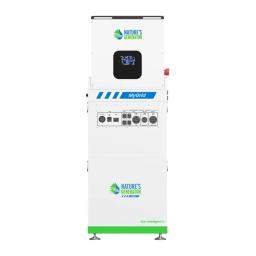
10,496Wh battery
Nature's Generator MyGrid 10K Gen 2
- 10 kWh
- expands to 73 kWh
- 10,000 W continuous
- 120/240V
10 kW at 120/240V and 10.5 kWh in one box, expandable to 73 kWh. For running most of a house, central AC included, through a long outage.
- 10,000 W at 120/240V with L14-30R and 14-50R outlets
- 10.5 kWh base, up to 73.5 kWh with six MyGrid batteries
- 5-year limited warranty
- Curbside freight delivery; you move it into place
- 152 lb inverter unit, 213 lb per add-on battery (maker)
About $7,000 at Nature's Generator, checked Oct 19, 2026
Check price at Nature's GeneratorPaid link. We earn a commission at no cost to you.
EcoFlow DELTA Pro Ultra X
- 12 kWh
- expands to 61 kWh
- 12,000 W continuous
- 120/240V
The biggest portable stack sold direct: 12 kW at 120/240V and 12 kWh in the base bundle. For homes that want central AC on battery.
- 12,000 W at 120/240V, the highest output in this list
- 12.3 kWh in the base bundle, expandable to 61.4 kWh
- 10,000 W solar input
- 292 lb base bundle
- 20 ms switchover, not a 0 ms UPS
Over $2,000, live price on Amazon
Check price on AmazonPaid link. We earn a commission at no cost to you.
Some of these links pay us a commission and some do not; each card says which. Commissions do not affect which models the tool picks or how it ranks them. See our disclosure.
Home battery size chart: kWh by load and outage length
Battery capacity to buy for common essential-load lists, with the calculator's 20% reserve and 90% inverter efficiency, plus the continuous and start-up power the inverter must supply.
| Loads | Daily use | 1 day | 2 days | 3 days | Power: continuous / peak | 240V? |
|---|---|---|---|---|---|---|
| Fridge, Wi-Fi, 4 LED lamps, phone | 1.8 kWh | 2.4 kWh | 4.9 kWh | 7.3 kWh | 240 W / 1,390 W | No |
| CPAP, fridge, Wi-Fi, lamps, phone | 2.2 kWh | 2.9 kWh | 5.7 kWh | 8.6 kWh | 280 W / 1,440 W | No |
| Fridge, gas furnace blower, Wi-Fi, lamps, phone | 4.2 kWh | 5.6 kWh | 11.3 kWh | 16.9 kWh | 900 W / 2,220 W | No |
| Above plus a chest freezer and 1/3 HP sump pump | 5.8 kWh | 7.7 kWh | 15.3 kWh | 23.0 kWh | 1,890 W / 3,210 W | No |
| Fridge, furnace, Wi-Fi, lamps, phone, 1/2 HP well pump, sump pump | 6.0 kWh | 8.0 kWh | 16.1 kWh | 24.1 kWh | 2,880 W / 5,080 W | Yes |
| Above plus a 12,000 BTU window AC | 11.3 kWh | 15.1 kWh | 30.2 kWh | 45.2 kWh | 4,090 W / 6,510 W | Yes |
| Fridge, furnace, Wi-Fi, lamps, phone, 3 ton central AC | 18.2 kWh | 24.3 kWh | 48.6 kWh | 72.9 kWh | 4,750 W / 11,900 W | Yes, installed system |
Past about 40 kWh or 12 kW, or with central AC and no soft starter, the calculator recommends an installed system instead of a portable stack. Solar panels shrink the number (the tool credits 4 peak-sun hours at a 75% derate). For plug-in systems that need no electrician, see the best home battery backup without an installer.
How this calculator works
A home battery has to clear three separate bars: enough stored energy (kWh), enough continuous power (kW) and enough surge to start motors. Energy is watts times hours. A 150 W fridge whose compressor runs a third of the time uses about 1.3 kWh a day, and a 600 W furnace blower running half of an 8 hour heating window uses 2.4 kWh. That duty cycle matters. Thermostat-driven loads like fridges, freezers, furnaces and space heaters draw their nameplate watts only part of the time, and the appliance table applies a typical cycle to each one so the tool does not oversize by a factor of two or three.
Continuous power is the sum of everything running at once. Surge is that sum plus the largest single start-up spike, because motors draw two to four times their running watts for a fraction of a second. A well pump at 1,000 W running and 3,000 W starting is a 2,000 W spike on top of whatever else is on. The tool adds 10% to both numbers and rejects any system whose inverter cannot cover them, no matter how large its battery.
240V is a hard line. Well pumps, central AC, heat pumps, electric dryers, ranges and water heaters run on two hot legs of 120V. A unit that only outputs 120V cannot run them even through a transfer switch. Units that output 120/240V split phase from a single box include the Anker SOLIX F3800 and F3800 Plus, EcoFlow DELTA Pro Ultra and DELTA Pro 3, BLUETTI Apex 300 and Jackery Explorer 5000 Plus. The Jackery HomePower 3600 Plus needs a second unit and the BLUETTI Elite 200 V2 cannot do it at all.
Days of autonomy is the multiplier that drives cost. One day of essentials is 5 to 7 kWh of battery after a 20% reserve and inverter losses. Three days is 15 to 20 kWh. Solar helps less than people hope. We credit panel watts times 4 peak-sun hours times a 0.75 derate for angle, clouds and charge losses, and we never let solar replace more than 75% of storage, because the outage that matters is the one in a December ice storm. For anything over two days a small inverter generator that tops the battery up for a few hours a day is cheaper than more packs.
Portable whole-home batteries make sense up to roughly 30 to 40 kWh and 12 kW. Past that, or if central AC without a soft starter is on the list, an installed system (Tesla Powerwall 3, Enphase IQ Battery, FranklinWH) with a backup gateway is cheaper per kWh, and handles whole-panel loads. The tool says so when you cross that line and still shows the largest portable option as an essentials-only fallback.
Finally, the hookup. Extension cords cost nothing and work for anything that plugs into a wall, with someone home to move plugs. A generator inlet on the outside wall plus an interlock kit or a 6 to 10 circuit manual transfer switch lets your real circuits run from the battery through existing wiring for a few hundred dollars in parts and a short electrician visit. A smart panel (EcoFlow Smart Home Panel 2, Anker SOLIX Smart Home Power Kit, Jackery Smart Transfer Switch) switches up to 12 circuits automatically in about 20 ms, sheds loads as the battery drains and runs time-of-use arbitrage the rest of the year, for $1,400 to $1,800 plus a day of labor.
Worked examples
Fridge, furnace, Wi-Fi, lights, phone for 2 days
- Refrigerator 150 W, 24 h, 35% duty
- Gas furnace blower 600 W, 8 h, 50% duty
- Wi-Fi router 15 W, 4 LED lamps 36 W, phone charger 10 W
- 2 days, no solar, extension cords
11.3 kWh, 0.9 kW continuous. Best fit: Anker SOLIX F3800 plus two BP3800 batteries and a furnace transfer switch.
Daily energy is 4,230 Wh. Two days with a 20% reserve and 90% inverter efficiency comes to 11.3 kWh of battery. Continuous draw is only 900 W and the fridge start-up pushes peak to 2.2 kW, so power is not the constraint. Best fit and budget was an Anker SOLIX F3800 with two BP3800 expansion batteries (11.5 kWh stored, 59 hours at the average load). The runner-up was an EcoFlow DELTA Pro Ultra with one extra battery (12.3 kWh stored, 63 hours). The furnace blower is the only hardwired load, so instead of a panel the kit adds a furnace transfer switch that lets one more cord from the battery run it.
Add a 1/2 HP well pump and sump pump for 3 days
- Everything in the first example
- Well pump 1/2 HP, 1,000 W running, 3,000 W start, 240V, 1 h
- Sump pump 1/3 HP, 800 W running, 2,000 W start, 2 h at 50% duty
- 3 days, no solar, transfer switch
24.1 kWh, 2.9 kW, 240V required. Best fit: DELTA Pro Ultra plus three extra batteries and the Smart Home Panel 2.
Daily energy rises to 6,030 Wh and three days needs 24.1 kWh. Continuous draw is 2.9 kW with a 5.1 kW start-up peak, and the well pump makes 240V split phase mandatory, which removes the Elite 200 V2 and HomePower 3600 Plus from the running. Best fit and budget was a DELTA Pro Ultra with three extra batteries (24.6 kWh stored, roughly 88 hours), with EcoFlow's Smart Home Panel 2 so the pump and furnace circuits switch over by themselves. The tool warned that three days with no recharge means buying battery you rarely use and that at 24 kWh an installed quote is worth getting.
Add a 12,000 BTU window AC and 800 W of solar for 2 days
- Everything in the second example
- Window AC 12,000 BTU, 1,100 W, 3,300 W start, 8 h at 60% duty
- 2 days, 800 W of portable solar, transfer switch
25.4 kWh after solar, 4.1 kW. Best fit: DELTA Pro Ultra plus four extra batteries.
Daily energy is 11,310 Wh, so two days needs 30.2 kWh before solar. 800 W of panels at 4 peak-sun hours and a 75% derate returns 4.8 kWh over two days, leaving 25.4 kWh of battery. Continuous draw is 4.1 kW and the AC start-up gives a 6.5 kW peak. Best fit was again a DELTA Pro Ultra, now with four extra batteries (30.7 kWh stored, about 59 hours). The 800 W of solar only trimmed 16% off the battery. The AC is what drives the cost.
Frequently asked questions
How big a battery do I need for a 3 day power outage?
About 17 kWh for basic essentials with gas heat, and about 24 kWh on a well. A fridge, gas furnace blower, Wi-Fi, four LED lamps and a phone charger use 4.2 kWh a day, so three days with a 20% reserve and 90% inverter efficiency is 16.9 kWh. Add a 1/2 HP well pump and a 1/3 HP sump pump and the total is 24.1 kWh, and the battery must put out 120/240V. Solar panels or a small generator that recharges the battery for a few hours a day cut that a lot.
How many kWh battery do I need to run a refrigerator?
About 1.7 kWh per day. A full-size fridge draws 150 W while the compressor runs, about 35% of the time, so it uses 1.26 kWh a day. With the calculator's 20% reserve and 90% inverter efficiency that is 1.68 kWh of battery per day, and the inverter needs about 1,200 W of surge for the compressor start. Two days is about 3.4 kWh.
How many kWh does it take to run a house?
The average US home uses about 30 kWh a day, but almost nobody backs up the whole house with a battery. Essentials (fridge, freezer, furnace blower, Wi-Fi, lights, phones, a sump pump) run 4 to 7 kWh a day. Add a well pump and a window AC and you are at 10 to 12 kWh a day. Multiply by your outage days, add 20% reserve and divide by 0.9 for inverter losses and you have the battery size.
Can a portable power station run a whole house?
A whole-home class unit (6 to 12 kW with 240V output) can run every circuit in a typical house at once except central AC, an electric water heater, an electric range or an EV charger. Those four loads each draw 3.5 to 10 kW and would drain a 10 kWh battery in an hour or two. What most people do instead is put in a transfer switch that backs up 6 to 12 chosen circuits and leave the big resistive loads off.
Anker SOLIX F3800 Plus or EcoFlow DELTA Pro Ultra?
The F3800 Plus is one 137 lb box with 3.84 kWh, 6 kW and 240V, and you add 3.84 kWh packs up to 26.9 kWh. The DELTA Pro Ultra is a separate inverter and battery (164 lb together) with 6.1 kWh, 7.2 kW and 240V, expandable to 30.7 kWh per inverter. Per kWh the DELTA Pro Ultra extra battery is cheaper than the BP3800 at current prices, so above about 8 kWh the EcoFlow stack usually costs less. Under 8 kWh and for a unit you will also roll out to the driveway, the Anker is simpler.
Do I need a transfer switch for a home battery?
Only if you want hardwired loads to run. A fridge, router, lamps and a plug-in sump pump can run on extension cords. A furnace blower, well pump, central AC, water heater or anything 240V is wired into your panel and needs either a manual transfer switch with an inlet (about $300 to $900 in parts plus electrician time) or a smart panel ($1,400 to $1,800) that switches circuits automatically. Never backfeed through a wall outlet. It can kill a line worker.
Can a battery run a well pump?
Yes, if the battery supplies 240V split phase and its surge rating covers the pump start. A 1/2 HP pump draws about 1,000 W running and 3,000 W to start, and a 1 HP pump draws 2,000 W and 6,000 W. The F3800 Plus, DELTA Pro Ultra, DELTA Pro 3, Apex 300 and Explorer 5000 Plus all qualify. The Elite 200 V2 and a single HomePower 3600 Plus are 120V only. Pumps only run a few minutes per hour, so they barely dent the kWh. Surge and voltage are the whole problem.
How long will 10 kWh last in an outage?
Divide usable energy by your average load. 10 kWh at 90% inverter efficiency is 9 kWh usable. An essentials load that averages 180 W (4.3 kWh a day) runs about 50 hours. Add a window AC for 8 hours a day and the average climbs to 470 W, which cuts it to about 19 hours. The tool shows this number for every pick.
LiFePO4 or NMC for home backup?
LiFePO4 (LFP). It is rated for 3,000 to 6,000 full cycles against about 500 to 1,000 for NMC, it tolerates sitting at full charge for months, and it is far harder to push into thermal runaway. Every system in this tool is LFP. NMC still shows up in cheap, light camping units where weight matters more than lifespan.
Is a battery cheaper than a generator?
Up front, no. A 7 kW dual-fuel inverter generator with a transfer switch is $1,500 to $2,500. The same output from a battery with 10 kWh of storage is $6,000 to $10,000. The battery wins on silence, zero fuel storage, no carbon monoxide, no maintenance and instant switchover, and it earns its keep year round on time-of-use rates or with solar. For outages longer than two days, the cheapest reliable setup is a mid-size battery plus a small inverter generator to recharge it.
Can I add solar later?
Yes. Every unit here has MPPT solar inputs from 1,000 W (Elite 200 V2) to 5,600 W (DELTA Pro Ultra). Portable panels can be bought later and plugged in. What does not work automatically is a rooftop grid-tied array, which shuts down in an outage. It needs a hybrid inverter or an installed battery system to keep producing when the grid is down.
Does a home battery work as a UPS?
The whole-home units switch in 10 to 20 ms, which keeps computers, routers and most appliances running. The Explorer 5000 Plus advertises 0 ms in online UPS mode. That is fast enough for a home office but not guaranteed for sensitive lab or medical gear, which should stay on a dedicated double-conversion UPS plugged into the battery.
Marcus Reed
Founder and Editor, CrunchYourDollars
Marcus Reed builds the sizing tools on CrunchYourDollars. He is a software engineer with a long-running PC hardware and power supply habit, which is where the watts, watt-hours and surge math on this site comes from. Product specs are pulled from manufacturer data sheets, electricity rates from the U.S. Energy Information Administration, and water chemistry rules from the Water Quality Association. He is not a licensed electrician or plumber: the tools show the math and the matching models so you can make the call, and anything involving your electrical panel should be checked by a licensed pro.
More about CrunchYourDollars and how we researchGet notified when we add tools
An occasional email when a new sizing tool goes live or the product database is refreshed. No spam, unsubscribe anytime.