A generator is the fastest way through a short outage, but in a long crisis it has a hard limit: fuel. Gasoline goes stale in months, stations need power to pump it, and in a war or a regional grid failure it may simply not be for sale. Solar panels with a battery keep producing every sunny day for as long as the equipment lasts.
Our picks at a glance
From published specs and our sizing rules. Not lab tested.
- 1
Best for most homes
BLUETTI AC200L
2,048 Wh battery
Check price at BLUETTIPaid link
- 2
Starter system
BLUETTI AC180
1,152 Wh battery
Check price at BLUETTIPaid link
- 3
Run the kitchen
EcoFlow DELTA Pro 3
4,096 Wh battery
Check price on AmazonPaid link
Size the system to the loads that matter, not the whole house. Using the appliance figures in our sizing tools, a full-size fridge uses about 1,260 Wh a day, a chest freezer about 720 Wh, four LED lamps for 5 hours 180 Wh and two phone charges about 60 Wh. A CPAP without its heated humidifier uses about 320 Wh a night. Fridge, lights and phones together are about 1,500 Wh a day.
For planning we assume each watt of panel makes 3 Wh a day: 4 hours of good sun, minus about 25% for heat, angle, dust and charging losses. In a northern winter, plan on half that. The calculator below ranks each power station here by how long it runs the loads you tick, and every row has a buy button.
Top picks, and why
2,048Wh battery
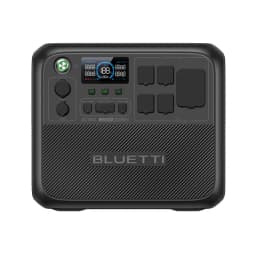
BLUETTI AC200L
- 2.0 kWh
- expands to 8 kWh
- 2,400 W continuous
2,048 Wh of LiFePO4 with 2,400 W output and up to 1,200 W of solar input, expandable with add-on batteries. With four 200 W panels it can make about 2,400 Wh on a decent day, enough for a fridge, lights, phones and a CPAP. about $899.
- 30 A RV outlet for a camper
- Expands to 8,192 Wh, about 4 days of fridge
- 1,200 W solar input
- Over 60 lb at 62.4 lb
- Not split-phase, no 240V
About $899 at BLUETTI, checked Oct 10, 2026
Check price at BLUETTIPaid link. We earn a commission at no cost to you.
1,152Wh battery
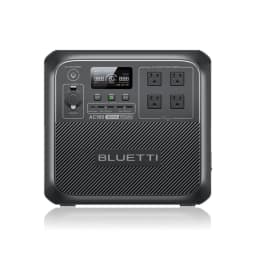
BLUETTI AC180
- 1.2 kWh
- 1,800 W continuous
1,152 Wh of LiFePO4 with 1,800 W output and up to 500 W of solar input. Two 200 W panels make about 1,200 Wh on a good day, enough for a chest freezer, lights, phones and a radio. about $499.
- 1,152 Wh, most capacity of the 1 kWh class
- About 19 hours of fridge or 3 CPAP nights
- 1,800 W inverter runs a coffee maker or microwave
- Heaviest of the 1 kWh class at 35.3 lb
- Previous-generation model with 20 ms switchover
About $499 at BLUETTI, checked Oct 10, 2026
Check price at BLUETTIPaid link. We earn a commission at no cost to you.
EcoFlow DELTA Pro 3
- 4.1 kWh
- expands to 12 kWh
- 4,000 W continuous
- 120/240V
4,096 Wh, 4,000 W output and up to 2,600 W of solar input, expandable to 12 kWh. Big enough to run a fridge and freezer, cook on an induction burner and still carry the night. over $2,000.
- 120/240V split-phase output
- Home panel compatible
- 2,600 W solar input, highest in our list
- Over 100 lb at 113.5 lb
Over $2,000, live price on Amazon
Check price on AmazonPaid link. We earn a commission at no cost to you.
Will it run your stuff?
Tick what you need to keep running. Every pick below re-sorts by how long it lasts on one charge.
Average draw about 89 W, peak about 1,236 W when the biggest motor starts.
- Check price on Amazon
EcoFlow DELTA Pro 3
4,096 Wh, Over $2,000
about 39 hours
Paid link
- Check price at BLUETTI
BLUETTI AC200L
2,048 Wh, About $899 at BLUETTI
about 20 hours
Paid link
- Check price on Amazon
Jackery Explorer 2000 Plus
2,042 Wh, $1,000 to $2,000
about 20 hours
Paid link
- Check price at BLUETTI
BLUETTI AC180
1,152 Wh, About $499 at BLUETTI
about 11 hours
Paid link
- Check price on Amazon
EcoFlow DELTA 3 Plus
1,024 Wh, $500 to $1,000
about 10 hours
Paid link
Runtime = capacity x 0.85 inverter efficiency / average draw, with fridges and freezers cycling on their compressors. Amazon links are paid links. Amazon prices change, so we show a range.
Compare every pick
Paid links: we earn a commission if you buy, at no cost to you. Amazon prices change often, so we show a range and link to the live price.
Size it: loads, battery, panels
Start with daily watt-hours. Fridge, four LED lamps and two phones come to about 1,500 Wh a day. Swap the fridge for a chest freezer and it drops to about 960 Wh. Add a CPAP and it rises by about 320 Wh a night. Leave out anything that heats: a 1,500 W space heater would drain a 2 kWh battery in under two hours.
The battery has to carry the night and a cloudy day. A good rule is at least one full day of use in storage, and two if you can afford it. For 1,500 Wh a day, that means a 2 kWh station at minimum.
Panels refill it. At our planning figure of 3 Wh per panel watt per day, 1,500 Wh needs about 500 W of panels in good sun and about 1,000 W in a northern winter. Check that the station's solar input can take that many watts, and buy panels the station's maker lists as compatible or that match its voltage range.
Jackery Explorer 2000 Plus
- 2.0 kWh
- expands to 12 kWh
- 3,000 W continuous
2,042 Wh with 3,000 W output and up to 1,400 W of solar input, expandable to 12 kWh with add-on battery packs, so you can start small and grow. $1,000 to $2,000.
- Expands to 12 kWh, about 7 days of fridge
- 3,000 W inverter with 6,000 W surge
- 1,400 W solar input for faster panel recharging
- Over 60 lb at 61.5 lb
- Not split-phase, no 240V
$1,000 to $2,000, live price on Amazon
Check price on AmazonPaid link. We earn a commission at no cost to you.
EcoFlow DELTA 3 Plus
- 1.0 kWh
- expands to 5 kWh
- 1,800 W continuous
1,024 Wh, 1,800 W output and up to 1,000 W of solar input, expandable to 5 kWh. A lot of solar input for its size, so it refills fast on short winter days. $500 to $1,000.
- 1,000 W solar input, double the DELTA 3
- Expands to 5 kWh, about 2 days of fridge
- Six AC outlets and 10 ms UPS switchover
- 1,024 Wh base, about 17 hours of fridge before expansion
- Not split-phase, no 240V
$500 to $1,000, live price on Amazon
Check price on AmazonPaid link. We earn a commission at no cost to you.
Panels
Folding portable panels set up in minutes, store in a closet and can be moved to follow the sun, which matters in winter. Rigid panels cost less per watt and last longer outdoors, but need a mount. Either way, aim them south in the US and tilt them more steeply in winter.
Lay panels out of sight where you can. In a long crisis, a lit house on a dark street and a row of panels in the front yard draw attention. A back yard, a flat roof or a balcony is better.
BLUETTI PV200 portable solar panel (200 W)
A 200 W folding panel made for BLUETTI power stations. Two make a starter array for the AC180 and four fill the AC200L. $250 to $500.
- Listed for AC180, AC200L and Elite 200 V2
- Kickstands built in
- 23.4% monocrystalline cells
- 17.2 lb folded
$250 to $500, live price on Amazon
Check price on AmazonPaid link. We earn a commission at no cost to you.
Callsun 200W N-Type Bifacial Solar Panel
- Bifacial
- Voc 27.3 V
- 51.3 x 30.3 in
- 23.8 lb
A 200 W bifacial rigid panel. Cheaper per watt than folding panels and built to stay outdoors, if you can mount it on a rack or roof. Check its voltage against your station's solar input. about $161.99.
- Split-cell design keeps one half producing when the other is shaded
- IP68 junction box, tempered glass, aluminum frame
- Callsun's store sells 2, 4, 8, 12 and 16 packs
- 51.3 x 30.3 in and 23.8 lb per panel
- Needs mounting hardware for a roof or ground rack
About $161.99 at Callsun, checked Oct 24, 2026
Check price at CallsunPaid link. We earn a commission at no cost to you.
Make the power go further
Cut the load before you buy more battery. A chest freezer uses far less than an upright fridge for the same space. Open the fridge as little as possible. Use LED lights only in the room you are in. Charge phones and radios in the middle of the day when the panels are producing, and run anything heavy then too, straight from the sun instead of the battery.
For a gas furnace, the blower needs power but the heat comes from gas. A furnace blower draws about 600 W while it runs, which a 2 kWh station can carry for a few hours a night. Our best heat source for a power outage guide covers the options, and heating with electricity from a battery is almost never practical.
If you also have a generator, run it a few hours a day to recharge the battery and save fuel, rather than running it all night. Our generator fuel calculator shows how long a tank lasts.
The bottom line
From published specs and our sizing rules. Not lab tested.
- 1
Best for most homes
BLUETTI AC200L
2,048 Wh battery
Check price at BLUETTIPaid link
- 2
Starter system
BLUETTI AC180
1,152 Wh battery
Check price at BLUETTIPaid link
- 3
Run the kitchen
EcoFlow DELTA Pro 3
4,096 Wh battery
Check price on AmazonPaid link
Frequently asked questions
How many solar panels do I need to run a fridge?
A full-size fridge uses about 1,260 Wh a day in our appliance table. At a planning yield of 3 Wh per panel watt per day, that is about 420 W of panels in good sun, so two to three 200 W panels, plus a battery of at least 1.5 to 2 kWh for nights. Double the panels for northern winters.
Solar generator or gas generator for a long outage?
For a short outage a gas generator delivers more power for less money. For weeks or months, fuel becomes the limit: gasoline goes stale and may not be for sale. Solar keeps producing as long as the sun shines. Many households keep both and run the generator only to top up the battery.
Can a solar generator run a whole house?
Not a typical whole house. Portable stations cover essentials: fridge, freezer, lights, phones, medical devices, a furnace blower for a few hours. Central AC, electric heat, ovens and dryers need far more than portable panels can supply.
How long do power station batteries last?
The stations here use LiFePO4 cells, which makers typically rate for thousands of charge cycles before capacity drops noticeably. That is many years of daily cycling, which suits a long crisis.
Do solar panels work in winter?
Yes, but they produce much less because days are short and the sun is low. Plan on roughly half the summer output in northern states, tilt the panels steeply and clear snow off them.
7 products are linked on this page. We have not lab-tested these products; picks are based on published specifications and our sizing rules. Amazon prices change, so we show a range and link to the live price. See our disclosure.
Size it for your home
Marcus Reed
Founder and Editor, CrunchYourDollars
Marcus Reed builds the sizing tools on CrunchYourDollars. He is a software engineer with a long-running PC hardware and power supply habit, which is where the watts, watt-hours and surge math on this site comes from. Product specs are pulled from manufacturer data sheets, electricity rates from the U.S. Energy Information Administration, and water chemistry rules from the Water Quality Association. He is not a licensed electrician or plumber: the tools show the math and the matching models so you can make the call, and anything involving your electrical panel should be checked by a licensed pro.
More about CrunchYourDollars and how we researchGet notified when we add tools
An occasional email when a new sizing tool goes live or the product database is refreshed. No spam, unsubscribe anytime.