Orange rings in the toilet, rust on the fixtures, and a softener that seems to quit after a year. That is what iron does to a well. What you should buy depends on one number from your water test. Under 1 ppm of clear-water iron, a two-tank metered softener rated for iron handles it on its own, and the Aquasure Harmony 48K ($500 to $1,000) or the Fleck 5600SXT 48K ($500 to $1,000) is the buy.
Our picks at a glance
From published specs and our sizing rules. Not lab tested.
- 1
Best for 1 to 7 ppm iron
SpringWell WS1 Well Water Iron Filter
12 gallons per minute
View at SpringWellNot a paid link
- 2
Budget, softener alone under 1 ppm
Aquasure Harmony Series 48,000 Grain Softener
48,000 grain capacity
Check price on AmazonPaid link
- 3
Heavy iron, sulfur or manganese
US Water Systems Matrixx inFusion Iron and Sulfur Filter (15 GPM)
15 gallons per minute
View at US Water SystemsNot a paid link
From 1 to 7 ppm, put a SpringWell WS1 air-injection iron filter ahead of a SpringWell SS1 or SS4 softener. Above 7 ppm, or with a strong rotten-egg smell or manganese staining, step up to the US Water Systems Matrixx inFusion peroxide system with a Matrixx 48K or 64K behind it.
Iron affects a softener in two ways. Dissolved (ferrous) iron gets captured by softener resin just like calcium, so softeners can handle small amounts. It also fouls the resin over time, and each 1 ppm of iron eats capacity like 4 grains per gallon of hardness. Oxidized (ferric) iron, the red particles that stain fixtures, is not captured at all. It plugs the resin bed. No matter what the box says, a softener is the wrong tool for red water.
Before you buy anything, get a lab test that reports hardness in grains per gallon, iron in ppm, manganese, hydrogen sulfide and pH. SpringWell bundles a well water test with the WS1 for this reason. Everything below is sized from those numbers, and our water softener sizer runs the same math.
Top picks, and why
12gallons per minute
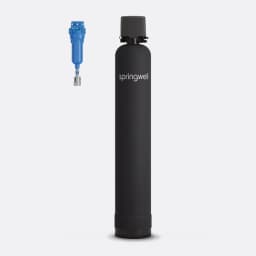
SpringWell WS1 Well Water Iron Filter
- 12 GPM
Air-injection iron filter that SpringWell rates for 7 ppm iron, 1 ppm manganese and 8 ppm hydrogen sulfide at 12 GPM, sized for 1 to 4 bathrooms. It sits ahead of the softener and takes the iron load, so you can size the softener on hardness alone and its resin lasts. Around $2,231 including the required well water test. Pair it with an SS1 or SS4.
- Removes up to 7 ppm iron and 8 ppm hydrogen sulfide
- Built for well water, rated for 1 to 4 bathrooms
- Includes the required well water test
- Filters iron, does not soften; pair with a softener
- Over 7 ppm iron needs a stronger system
About $2,231 at SpringWell, checked Oct 10, 2026
View at SpringWellNot a paid link. Sold by SpringWell.
Aquasure Harmony Series 48,000 Grain Softener
- 48,000 grain
- 12 GPM
Two-tank digital metered 48,000 grain softener at 12 GPM that Aquasure rates for 4 to 5 bathrooms. Retail listings give it a 10 ppm clear-water iron rating that Aquasure's own page does not publish, so we treat it as a sub-1 ppm softener and recommend a resin cleaner above 0.5 ppm. At $500 to $1,000 it is the cheapest two-tank unit in our database.
- 48,000 grains covers about 4 people at 15 gpg
- Rated for 4 to 5 bathrooms and 5 to 6 people
- Digital metered two-tank design
- Flow and iron ratings come from retail listings, not Aquasure
$500 to $1,000, live price on Amazon
Check price on AmazonPaid link. We earn a commission at no cost to you.
15gallons per minute
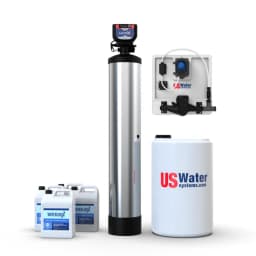
US Water Systems Matrixx inFusion Iron and Sulfur Filter (15 GPM)
- 15 GPM
Hydrogen peroxide injection system rated for 20 ppm iron, 30 ppm hydrogen sulfide and 1 ppm manganese at 15 GPM. Step up to this when air injection cannot keep up or the sulfur smell is strong. Around $3,395, with a 10 GPM version at $3,295. Pair it with a Matrixx 48K or 64K softener.
- Handles up to 20 ppm iron, the most we list
- Rated for 30 ppm hydrogen sulfide and 1 ppm manganese
- 15 GPM service flow
- Removes iron and sulfur, does not soften water
About $3,395 at US Water Systems, checked Oct 10, 2026
View at US Water SystemsNot a paid link. Sold by US Water Systems.
Compare every pick
Paid links: we earn a commission if you buy, at no cost to you. Amazon prices change often, so we show a range and link to the live price.
Clear-water iron vs red-water iron
Fill a clear glass from the well and let it sit for 20 minutes. Water that comes out clear and slowly turns cloudy or rusty has ferrous (clear-water) iron, dissolved in the water and only oxidizing when it meets air. Water that comes out tinted or with visible particles has ferric (red-water) iron, already oxidized in the well or the pipes. Many wells have both. The lab test reports total iron, so the glass test is how you learn which kind dominates.
Softener resin exchanges ferrous iron the same way it exchanges calcium and magnesium. That is how the Whirlpool WHES40E can legitimately list a 10 ppm clear-water iron rating. But iron does not rinse off the resin as cleanly as hardness does during regeneration, so capacity drops month by month unless you use a resin cleaner. Ferric iron behaves differently. It is a particle, and it packs into the top of the bed until flow rate and softening both collapse.
An iron filter solves both problems. Air-injection units like the SpringWell WS1 oxidize ferrous iron into ferric and then trap the particles in a media bed that backwashes to drain. Peroxide units like the Matrixx inFusion use a stronger oxidizer for heavier loads and sulfur. Either way, the water reaching the softener is iron-free and the softener only has to soften.
The 4 gpg per ppm rule and sizing with iron in the water
When the softener handles the iron itself, size it on compensated hardness, which is hardness in gpg plus 4 times the iron in ppm. Daily grains = people x 75 gallons x compensated hardness. Multiply by 7 for a week, then divide by 0.7 to get the nominal rating to buy. The 0.7 accounts for running the softener at an efficient salt setting instead of its maximum.
Take a family of four on 12 gpg water with 0.8 ppm iron. Compensated hardness is 12 + 3.2 = 15.2 gpg. Daily grains come to 4 x 75 x 15.2 = 4,560, weekly to 31,920, and dividing by 0.7 gives 45,600. A 48K softener fits with a weekly regeneration. Raise the iron to 2 ppm and compensated hardness becomes 20 gpg. Daily grains are 6,000, weekly 42,000, and the nominal requirement is 60,000. That pushes you to a 64K unit, and it will still foul over time because 2 ppm is more than a softener should see.
Now put a WS1 ahead of the same house. The softener sees 12 gpg and no iron, so it needs 3,600 grains a day, 25,200 a week and 36,000 nominal. A 48K regenerates about every nine days on an efficient setting, and the iron never touches the resin. So the filter does more than protect the softener. It lets you buy a smaller one. At 5 people, 20 gpg and 3 ppm iron, the softener-only math gives 120,000 grains nominal, which no residential unit offers. In that house the filter is mandatory.
When a softener alone is enough, and when the filter comes first
Under 1 ppm of clear-water iron, a metered two-tank softener does the job as long as you feed it a resin cleaner. Iron removers such as Iron Out or Res Care go in the brine tank monthly, or through a small drip feeder, and keep the resin from loading up. The Aquasure Harmony 48K, the Fleck 5600SXT 48K and the Whirlpool WHES40E all fit this case. Set the hardness on the valve to the compensated figure. If you enter the raw hardness, it will regenerate too late.
From 1 ppm up we recommend an iron filter ahead of the softener, and above 3 ppm it is required. No softener rating survives that iron load. When manufacturers quote 7 or 10 ppm, they are describing what the resin will tolerate briefly. Years of it are another matter. The SpringWell WS1 covers 1 to 7 ppm at 12 GPM. The Matrixx inFusion covers up to 20 ppm, as high as any residential system in our database goes.
Order matters. Water should run through a sediment prefilter, then the iron filter, then the softener, then into the house. Put the softener first and it gets all the iron you just paid to remove. Air-injection filters need a drain line and a 120V outlet. The peroxide system also needs room for its solution tank and injection pump, so plan the mechanical room before ordering.
Sulfur smell, manganese and flow rating by bathrooms
A rotten-egg smell is hydrogen sulfide gas, and a softener does nothing about it. The WS1 is rated for 8 ppm, which handles the typical nuisance well. If the smell hits you at the tap from across the room, get the inFusion, rated for 30 ppm.
Manganese leaves black or brown staining in toilets and dishwashers. It behaves like iron but is harder to oxidize. Both the WS1 and the inFusion are rated to 1 ppm. Above that you are into custom treatment, and you should take the lab report to a water treatment dealer before buying anything off a product page. Salt-free conditioners handle none of this, and SpringWell's FutureSoft spec sheet lists 0 ppm iron and 0 ppm manganese.
Flow is the spec people forget. A 1 to 2 bathroom house needs 7 to 10 GPM of service flow, 3 to 4 bathrooms need 12 to 15 GPM, and 5 or more need 20 GPM. In a filter plus softener chain, the lowest-rated stage sets the limit. A WS1 (12 GPM) ahead of an SS4 (13 GPM) is a 12 GPM system, and an inFusion 15 ahead of a Matrixx 64K (20 GPM) is a 15 GPM system.
Picks in detail: the softener to put behind the filter
With an iron filter doing the hard work, the softener choice comes down to hardness, bathrooms and budget. The SpringWell SS line shares the WS1's dealer and warranty, and the Matrixx shares the inFusion's. The Fleck and Whirlpool are the value options that stand alone under 1 ppm. Of the four below, only the Whirlpool is rated for well water on its own, so treat the others as the second stage.
If the iron tested under 1 ppm and you are only buying one thing today, pick the Fleck, the Whirlpool or the Aquasure. Buying a filter and a softener together? Matching brands gets you one support line and one warranty.
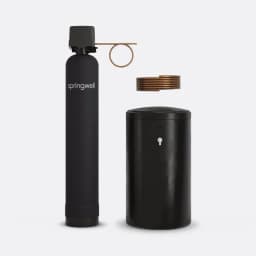
48,000grain capacity
SpringWell SS4 Salt-Based Softener (48,000 grain)
- 48,000 grain
- 13 GPM
48,000 grains at 13 GPM, rated by SpringWell for 4 to 6 bathroom homes, on the same metered valve and warranty as the SS1. Behind a WS1 the 12 GPM filter sets the system flow, which makes this the right size for a larger house at 12 to 20 gpg. Around $1,785. The 32,000 grain SS1 at around $1,607 covers 1 to 3 bathrooms under about 12 gpg.
- 48,000 grains covers about 4 people at 15 gpg
- Rated for 4 to 6 bathroom homes
- Same valve and warranty as the SS1, more resin
- Built for city water, not well water
- No carbon stage for chlorine taste
About $1,785 at SpringWell, checked Oct 10, 2026
View at SpringWellNot a paid link. Sold by SpringWell.
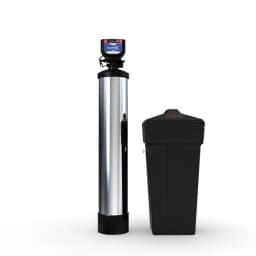
48,000grain capacity
US Water Systems Matrixx Smart Metered Softener 48K (1.5 cu ft)
- 48,000 grain
- 15 GPM
1.5 cubic feet of resin listed at 48,000 grains at maximum settings, 15 GPM service flow and a smart metered valve, for around $1,635. It matches the inFusion at 15 GPM, so neither stage bottlenecks the other. Step to the 64K (20 GPM, around $1,775) when hardness is above 18 gpg or the house has 5 bathrooms.
- 48,000 grains covers about 4 people at 15 gpg
- 15 GPM service flow from 1.5 cu ft of resin
- Smart metered valve
- 48,000 grain rating assumes the maximum salt setting
- No carbon stage for chlorine taste
About $1,635 at US Water Systems, checked Oct 10, 2026
View at US Water SystemsNot a paid link. Sold by US Water Systems.
AFWFilters Fleck 5600SXT 48,000 Grain Softener (10% crosslink resin)
- 48,000 grain
- 12 GPM
The Fleck 5600SXT metered valve with 1.5 cubic feet of 10 percent crosslink resin in a 10 x 54 tank, brine tank and bypass included, $500 to $1,000. Higher crosslink resin holds up better to iron and oxidizers than standard resin, which matters on a well. Program the valve to compensated hardness, feed it resin cleaner, and it will handle sub-1 ppm iron for years.
- Fleck 5600SXT metered valve
- 1.5 cu ft of 10% crosslink resin
- Bypass and brine tank included
- DIY kit, you handle the install
- No carbon stage for chlorine taste
$500 to $1,000, live price on Amazon
Check price on AmazonPaid link. We earn a commission at no cost to you.
Whirlpool WHES40E 40,000 Grain Softener
- 40,000 grain
- 8.5 GPM
Single-cabinet demand-regeneration softener rated by Whirlpool for 10 ppm clear-water iron, 125 gpg and 1 to 5+ people, $500 to $1,000. Its 8.5 GPM service flow limits it to 1 to 2 bathroom homes. We would not run it anywhere near 10 ppm. Under 1 ppm with resin cleaner, though, it is the cheapest iron-tolerant softener you can buy.
- Handles up to 10 ppm clear-water iron
- Up to 125 gpg hardness, for 1 to 5+ people
- Compact single-cabinet design
- 8.5 GPM flow, below the two-tank 48K units
$500 to $1,000, live price on Amazon
Check price on AmazonPaid link. We earn a commission at no cost to you.
Why salt-free is not for wells with iron
Salt-free conditioners use template-assisted crystallization to make hardness minerals form crystals that do not stick to pipes. They remove neither hardness nor iron, and iron coats the TAC media until it stops working. SpringWell lists 0 ppm iron for the FutureSoft. Aquasana's guidance for the Rhino conditioner is iron under 0.3 ppm, and iSpring says the same for its electronic descaler. We keep salt-free to city water under 25 gpg with iron under 0.3 ppm, and a well with measurable iron fails that test by definition.
To cut salt use on a well, put an iron filter in front of a salt-based softener on an efficient setting. You end up with soft water, which no conditioner delivers.
The bottom line
From published specs and our sizing rules. Not lab tested.
- 1
Best for 1 to 7 ppm iron
SpringWell WS1 Well Water Iron Filter
12 gallons per minute
View at SpringWellNot a paid link
- 2
Budget, softener alone under 1 ppm
Aquasure Harmony Series 48,000 Grain Softener
48,000 grain capacity
Check price on AmazonPaid link
- 3
Heavy iron, sulfur or manganese
US Water Systems Matrixx inFusion Iron and Sulfur Filter (15 GPM)
15 gallons per minute
View at US Water SystemsNot a paid link
Frequently asked questions
How much iron can a water softener handle on its own?
We draw the line at 1 ppm of clear-water iron with a monthly resin cleaner. Manufacturers quote higher figures (Whirlpool lists 10 ppm for the WHES40E, and retail listings give the Aquasure Harmony 10 ppm). Those figures describe short-term tolerance. Over years the resin fouls. Over 1 ppm, add an iron filter. Over 3 ppm, one is required.
What size softener for 4 people at 15 gpg with 1 ppm iron?
Compensated hardness is 15 + 4 = 19 gpg. Daily grains = 4 x 75 x 19 = 5,700, weekly is 39,900, and divided by 0.7 that is 57,000, so a 64K unit if the softener handles the iron. With an iron filter upstream you size on 15 gpg only: 4,500 daily, 31,500 weekly, 45,000 nominal, and a 48K fits.
Do I need an iron filter if my water is clear but stains the toilet?
Staining at 0.3 ppm or above is normal, which is why the EPA secondary standard for iron is 0.3 ppm. Clear water with light staining is usually under 1 ppm of ferrous iron, and a softener with resin cleaner removes it. Get the lab number. If it is above 1 ppm, the filter is the better long-term buy even though the water looks clear.
Will a softener remove the rotten-egg smell?
No. The smell is hydrogen sulfide gas, and ion exchange resin does not capture it. The SpringWell WS1 is rated for 8 ppm of hydrogen sulfide and the Matrixx inFusion for 30 ppm. If the smell is only in the hot water, try replacing the water heater's magnesium anode with an aluminum-zinc one first. In many homes that fixes it for under $50.
Can I use a salt-free softener on a well?
Not with iron present. TAC media is rated for 0 ppm iron by SpringWell and under 0.3 ppm by Aquasana, and it does not remove hardness in any case. On a well that tests at 0 ppm iron and under 25 gpg it is an option, but very few wells qualify. Iron filter plus salt-based softener is the combination that works.
What flow rate do I need?
Roughly 7 to 10 GPM for 1 to 2 bathrooms, 12 to 15 GPM for 3 to 4, and 20 GPM for 5 or more. The lowest-rated unit in the chain sets the limit, so a 12 GPM WS1 ahead of a 13 GPM SS4 gives you 12 GPM. Check that your well pump can deliver that flow too, since a 1/2 HP pump typically delivers around 10 GPM.
What does it cost to run an iron filter and softener?
The softener's valve draws about 5 W, around 44 kWh a year, or about $7. Salt for a family of four on 15 gpg water is roughly 10 to 16 bags of 40 lb a year, $100 to $150. An air-injection filter adds a backwash cycle every few days that uses 50 to 100 gallons of water. The peroxide system adds solution refills of roughly $100 to $200 a year depending on iron load. Our cost-to-run tool does the per-household math.
Does pH matter for an iron filter?
Yes. Air-injection filters oxidize iron best at neutral or slightly alkaline pH. Acidic well water (below about 6.5) slows the reaction and can corrode the system. If the lab test shows low pH, ask the manufacturer about a neutralizer ahead of the filter before ordering. Both SpringWell and US Water Systems will review the report.
How do I tell if my well has clear-water or red-water iron?
Fill a clear glass from the well and let it sit for 20 minutes. If it comes out clear and slowly turns cloudy or rusty, the iron is ferrous (clear-water) iron, which softener resin can exchange in small amounts. If it comes out tinted or with visible particles, it is ferric (red-water) iron, which plugs a softener's resin bed and needs an iron filter. Many wells have both, and the lab test gives the total iron in ppm.
Does the iron filter go before or after the water softener?
Before. The order is sediment prefilter, iron filter, softener, then the house, all after the well's pressure tank. Put the softener first and it catches the iron you paid the filter to remove, which fouls the resin. With the filter first, you size the softener on hardness alone.
7 products are linked on this page. We have not lab-tested these products; picks are based on published specifications and our sizing rules. Amazon prices change, so we show a range and link to the live price. See our disclosure.
Size it for your home
Marcus Reed
Founder and Editor, CrunchYourDollars
Marcus Reed builds the sizing tools on CrunchYourDollars. He is a software engineer with a long-running PC hardware and power supply habit, which is where the watts, watt-hours and surge math on this site comes from. Product specs are pulled from manufacturer data sheets, electricity rates from the U.S. Energy Information Administration, and water chemistry rules from the Water Quality Association. He is not a licensed electrician or plumber: the tools show the math and the matching models so you can make the call, and anything involving your electrical panel should be checked by a licensed pro.
More about CrunchYourDollars and how we researchGet notified when we add tools
An occasional email when a new sizing tool goes live or the product database is refreshed. No spam, unsubscribe anytime.